How a number gets onto the page.
Every figure here was read from an official publisher and carries its source and date. Market size, growth, risk and scenarios, for any industry and country.
- Read from the official publisher.
- Normalised onto the official industry codes and geographies.
- Checked by standing checks that run on every publish.
- Published with a grade, a source and a date; withheld with a reason when a check fails.
Served to you unchanged, with the same provenance on the web, in the export and through the API.
Every figure carries its source, its date and the grade it was published at.
Source: Eurostat, Net turnover (euros), 2023. Grade: actual. Read 31 July 2026.
The grades: actual, derived, source estimate, forecast, forecast range and scenario.
The total is the industry's published turnover.
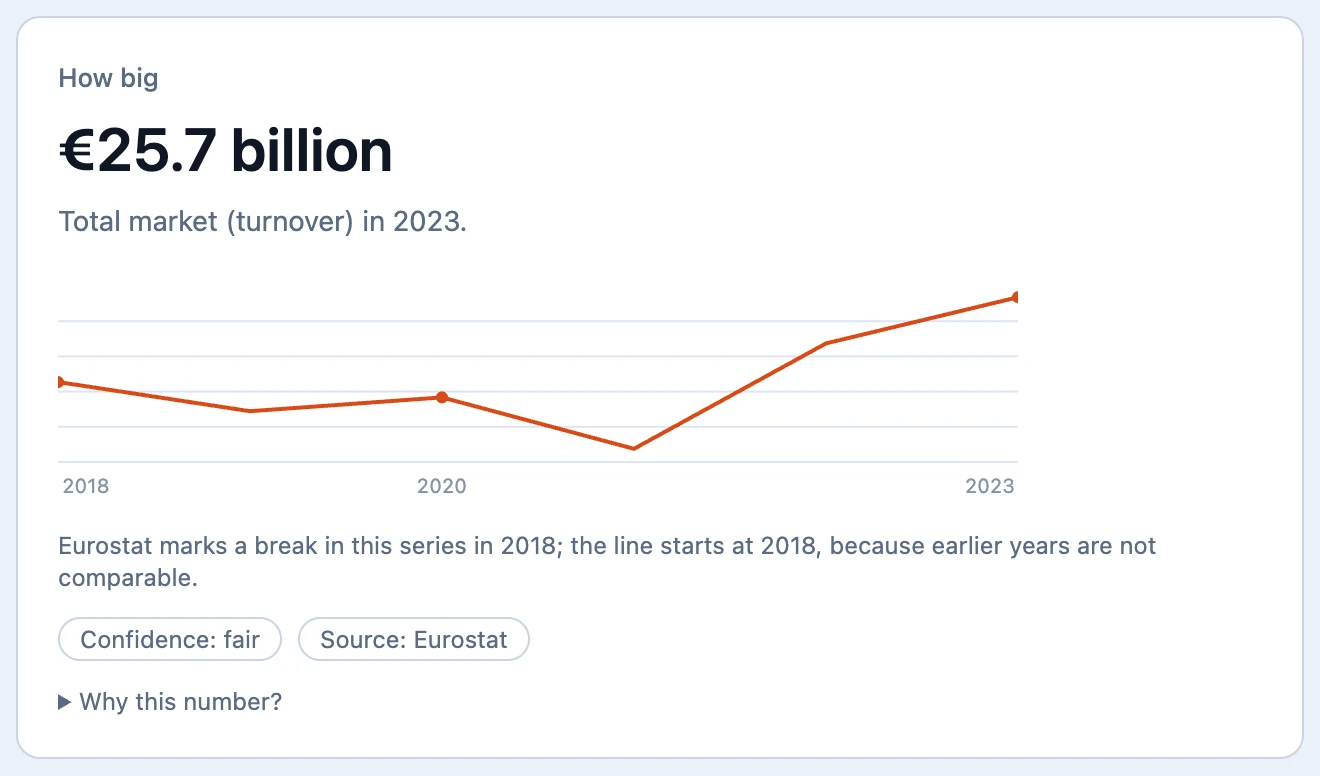
The AI: The assistant reads the figures the page already serves and answers from them. It never supplies a number of its own; if a figure is not in the data, the answer says so. Generated prose is labelled as generated.
Generated from the figures on this page.
Accuracy and withholding
If a number fails our checks, it is withheld and the page says why.
Withheld: the publisher marks this figure confidential.
No forecast for this market: we publish no forecast at sector level.
Where the numbers come from
- Eurostat
- the World Bank
- the IMF
- the OECD
- the UN Statistics Division
- the US Census Bureau
- the US Bureau of Labor Statistics
- the US Bureau of Economic Analysis
- the Office for National Statistics
- Statistics Canada
read directly from Eurostat, the World Bank, the IMF, the OECD and other official publishers
We never republish another company's forecast and never resell licensed data.
| Eurostat | Reuse of statistical data, metadata, publications, and other dissemination tools published on this website for commercial or non-commercial purposes is authorised provided the source is acknowledged.Copyright notice and free re-use of data |
| the World Bank | CC-BY-4.0 |
| the IMF | Whether obtained directly from the IMF or another party, when Data is distributed or reproduced in any manner, it must appear accurately with attribution to the IMF as the sourceCopyright and Usage |
| the OECD | Except where additional restrictions apply as stated above, you can extract from, download, copy, adapt, print, distribute, share and embed Data for any purpose, even for commercial use.Terms and Conditions |
| the UN Statistics Division | The United Nations grants permission to Users to visit the Site and to download and copy the information, documents and materials (collectively, “Materials”) from the Site for the User’s personal, non-commercial use, without any right to resell or redistribute them or to compile or create derivative works therefromTerms of Use |
| the US Census Bureau | You may use the Census Bureau API to develop a service or service to search, display, analyze, retrieve, view and otherwise "get" information from Census Bureau data.Census Bureau Application Programming Interface Terms of Service Agreement |
| the US Bureau of Labor Statistics | You are free to use our public domain material without specific permission, although we do ask that you cite the Bureau of Labor Statistics as the source.Copyright Information |
| the US Bureau of Economic Analysis | Citations are appreciated and appropriate.Guidelines for Citing BEA |
| the Office for National Statistics | Open Government Licence v3.0 |
| Statistics Canada | Statistics Canada Open Licence |